Body Horror by Anne Elizabeth Moore
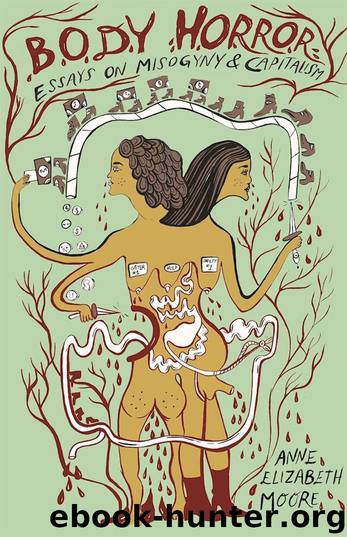
Author:Anne Elizabeth Moore
Language: eng
Format: epub
ISBN: 9781940430935
Publisher: Curbside Splendor Publishing
Published: 2017-04-19T04:00:00+00:00
You’ve heard of celiac disease, a diagnosis given to two to three times as many women as men, in which the body’s immune system attacks itself when triggered by the ingestion of gluten. Perhaps you’ve even reposted one of many articles claiming to debunk the wheat protein’s link to physical discomfort on social media, a sharable, friendly way to discredit women’s pain. (I know I have.)
However much the precise mechanics of the relationship between certain foods and autoimmune disease may not be understood, foodstuffs beyond gluten have been linked to certain autoimmune responses. Usually, autoimmunity is considered a medical mystery: for unknown reasons, doctors say, the body’s immune system turns on itself in the same way it would attack a parasite, virus, or other foreign invader. The resulting inflammation causes pain as well as physical impairment. Yet some health practitioners—naturopaths, in particular—root autoimmune disease in food sensitivities.
There are several food-elimination protocols suggested for the autoimmune, therefore: some name-brand, like the Paleo Diet, and others more tailored to individual responses, like the low FODMAP diet (to cut down on short-chain carbohydrates), elimination programs (to identify problem foods), low histamine diets (to quell allergic responses), and rotation diets (for those who can’t identify any specific food relationship to symptoms beyond ingestion). Such diets, however crazy they may sound to those who have not tried them, do tend to work for a large number of people.
Despite extensive anecdotal evidence, however, scientists have been slow to look into a relationship between consumption and autoimmunity. The reasons for this are likely myriad. While many in the post-Sanders campaign era would tend to blame Big Pharma’s exclusive focus on profits for the holdup, it may equally be due to the gender of the majority of sufferers. Although medicating illness is profitable, there are surely enormous profits to be made in staving off illness, if the price point for continued health is set high enough. It seems more likely that the tendency of the sciences to overlook autoimmunity is rooted in the low numbers of women in STEM (Sciences, Technology, Engineering, and Medicine). Women chemists, for example, make up only 35.2 percent of the field, and women chemical engineers only 22.7, according to analysis by the National Girls Collaborative Project. Nor are there enough women funders to ensure such studies take place: only 4.6 percent of the 2016 Fortune 500 CEOs are women, according to Catalyst, an organization that tracks women in business leadership. Women, earning on average 77 percent of what male counterparts do in the same jobs (specifically making $15,900 per year less than men in STEM jobs, according to a 2013 report by the US Census Bureau) do not currently have the economic clout as a class to fund or demand such studies. Anyway, those who perceive a clear need may be too ill to mount a campaign, or already wrapped up in the sustaining care work of blogging.8
Only recently, therefore, has a connection been proven between food and these poorly studied ailments. A
Download
This site does not store any files on its server. We only index and link to content provided by other sites. Please contact the content providers to delete copyright contents if any and email us, we'll remove relevant links or contents immediately.
| Anthropology | Archaeology |
| Philosophy | Politics & Government |
| Social Sciences | Sociology |
| Women's Studies |
The Secret History by Donna Tartt(19085)
The Social Justice Warrior Handbook by Lisa De Pasquale(12190)
Thirteen Reasons Why by Jay Asher(8909)
This Is How You Lose Her by Junot Diaz(6885)
Weapons of Math Destruction by Cathy O'Neil(6279)
Zero to One by Peter Thiel(5801)
Beartown by Fredrik Backman(5751)
The Myth of the Strong Leader by Archie Brown(5507)
The Fire Next Time by James Baldwin(5442)
How Democracies Die by Steven Levitsky & Daniel Ziblatt(5218)
Promise Me, Dad by Joe Biden(5153)
Stone's Rules by Roger Stone(5087)
A Higher Loyalty: Truth, Lies, and Leadership by James Comey(4960)
100 Deadly Skills by Clint Emerson(4924)
Rise and Kill First by Ronen Bergman(4788)
Secrecy World by Jake Bernstein(4752)
The David Icke Guide to the Global Conspiracy (and how to end it) by David Icke(4717)
The Farm by Tom Rob Smith(4507)
The Doomsday Machine by Daniel Ellsberg(4490)
